This marvelous document appears on the Tell Zell: What You Really Think blog, "courtesy of Andrew Spencer, now 10. Sent in and used with the permission of his mom, Gail Gedan Spencer, a blogger and copy editor at the Sun"
I'll just note a small part of her commentary, and encourage you to visit the site.
"I'm sending you something that I've had taped up at my work station for the past few years. It's a worksheet on careers that my son did in first grade. As you can see, a love of journalism must have passed into his DNA from my husband and me. It's hopeful and sad at the same time. (He now has more sensible career goals -- cartoon voice artist or professional sports team mascot.)"
I don't think we should despair about the future of newspapers. I think we should keep the faith.
It's not as if the last few months have been exactly
perky and upbeat around publishing offices across the U.S. But the last week seems
to have been completely inundated with a dismal torrent of bad news. Both Hearst
(3rd largest magazine publishing in the U.S.) and Hachette (dropped
out of the #10 spot in 2006, but presumably still in the top 15) lost their
chief executives - whatever language the companies used in
making the announcements, these guys got the boot.
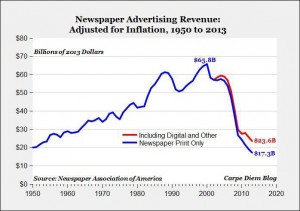
Meanwhile the big newspaper companies were reporting
horrible financial results: Gannett Co., which publishes more than eighty U.S.
newspapers, acknowledged that publishing ad revenue fell 14.3% in May. Its smaller
rival McClatchy Co. reported a 15% drop in newspaper ad revenue for the first
five months of the year and announced a 10% cut of its work force. New York
Times Co. said last Wednesday that ad revenue dropped 12%. And on June 17,
Bloomberg reported
that "Los Angeles Times and Chicago Tribune controlling investor Sam
Zell may be unable to stop the loss of advertising revenue leading him and
other U.S. newspaper publishers closer to default on billions of dollars in
debt."
My take on all of this is the opposite of Robert Schiller's
well-known phrase (and book title) "Irrational Exuberance." I call it Irrational Pessimism.
As I pointed out in my blog entry "Is
the Internet Really Destroying Newspapers?", quoting from a PEW report, "Even with so
many new sources, more people now consume what old media newsrooms produce,
particularly from print, than before. Online, for instance, the top 10 news Web
sites, drawing mostly from old brands, are more of an oligarchy, commanding a
larger share of audience than in the legacy media."
Yesterday I received the executive summary of PWC's "Global
Entertainment and Media Outlook: 2008-2012" (at 112 pages, it's a little more
than the average executive might expect in a summary!). The full report would
take me offline for weeks, but the executive summary represents a marvelous
chunk of research. Notable is PWC's prognosis for the newspaper industry:
continuing declines through 2009, followed by a return to modest growth.
As this chart from PEW illustrates, Hearst is not
suffering in terms of revenue growth. The two firings, as suggested in several
media reports, may have much more to do with internal company politics than with
failed strategies. (A fascinating article in Fortune, "Intrigue
at Hearst's Castle," examines the intricacies of Hearst's corporate
structure.)

These days it's very easy to get on the newspapers-are-dying
bandwagon. I think that the conclusion to this story is still to be written.
-30-
I am still reeling from Steve Ballmer's atrociously
ill-considered remarks
to The Washington Post (Ballmer, as most recall, is CEO of Microsoft,
when Bill G. is not at home) that "there will be no media consumption left in
10 years that is not delivered over an IP network. There will be no newspapers,
no magazines that are delivered in paper form. Everything gets delivered in an
electronic form."
My retort: "in 10 years there will be no software that
Microsoft will be able to profit from either in operating systems or as
shrink-wrapped software."
I am
willing to meet him for a duel at dawn.
More credit where credit is due: I was alerted to this provocative
May 2008 column on Slate.com by
Bob Sacks in his "'Heard on the Web'
Media Intelligence newsletter.
Back in the prehistoric era, i.e. 1993, mega-bestselling
author Michael Crichton wrote an article for Wired magazine called Mediasaurus.
In the article he made several predictions, expanding from the premise stated
in his first paragraph, "To my mind, it is likely that what we now understand
as the mass media will be gone within ten years. Vanished, without a trace."
Jack Shafer, Slate's "editor at large," revisits those
predictions with Crichton, as well as referencing his earlier visit with Crichton in the same
subject in 2002. When challenged that as of 2002 his predictions appeared still
far from accurate, Crichton responded: "I assume that nobody can predict the
future well. But in this particular case, I doubt I'm wrong; it's just too
early."
Crichton complains bitterly (as many other commentators
have noted) that the decline of newspapers and television are not simply
because of the Web alternative, but also the ever-decreasing quality of those
media.
Shafer notes Crichton's belief that "it will take a media
visionary…somebody like Ted Turner --to create the high-quality information
service he foresaw in his 1993 essay. In addition to building the service, the
visionary will also have to convince news consumers that they need it."
The
30+ comments that follow the article are the usual vituperative mumbo-jumbo;
the article itself, a good read.
The Project for Excellence in Journalism (PEJ) is a superb research organization funded by the Pew Research Center in Washington, D.C. Its website is a rich treasure trove of research, analysis and commentary tackling the challenge of "understanding news in the digital age."
PEJ's flagship report is its annual State of the News Media. The 2008 edition was published on March 17th, 2008. The report covers not just newspapers, but television, magazines, radio, online and more. The full report is some 700 pages, highly-readable, and exhaustive – but also exhausting. I quote from parts of the report in various sections of this site.
PEJ drops a little bombshell in the introduction and overview to the 2008 report. While acknowledging that "state of the American news media in 2008 is more troubled than a year ago," it continues that "the problems, increasingly, appear to be different than many experts have predicted."
Pointing to Chris Anderson's famous The Long Tail theory, it states that "critics have tended to see technology democratizing the media and traditional journalism in decline. Audiences, they say, are fragmenting across new information sources, breaking the grip of media elites. Some people even advocate the notion of "The Long Tail," the idea that, with the Web's infinite potential for depth, millions of niche markets could be bigger than the old mass market dominated by large companies and producers."
However, the introduction continues, "the reality, increasingly, appears more complex. Looking closely, a clear case for democratization is harder to make. Even with so many new sources, more people now consume what old media newsrooms produce, particularly from print, than before. Online, for instance, the top 10 news Web sites, drawing mostly from old brands, are more of an oligarchy, commanding a larger share of audience than in the legacy media (emphasis mine). The verdict on citizen media for now suggests limitations. And research shows blogs and public affairs Web sites attract a smaller audience than expected and are produced by people with even more elite backgrounds than journalists (emphasis mine)."
As I've pointed out repeatedly on this site, and others never tire to reiterate, newspapers are unquestionably facing serious circulation and revenue challenges. But as the heavily-concentrated newspaper industry slowly adjusts to the new economic realities of the Web, and quite conceivably masters them, they may find their brands stronger than ever.
The ever-reliable New Yorker checked in late last month with a long analysis on the fate of the newspaper industry. Entitled "Out of Print: The death and life of the American newspaper," author Eric Alterman sounds no more cheerful than the rest of us as to where newspapers are headed. Early in the article he states: "Few believe that newspapers in their current printed form will survive. Newspaper companies are losing advertisers, readers, market value, and, in some cases, their sense of mission at a pace that would have been barely imaginable just four years ago." He continues: "Few corporations have been punished on Wall Street the way those who dare to invest in the newspaper business have."
Alterman, notes, as many have, to the changing newspaper readership demographic. He highlights the "ironic injustice…that when a reader surfs the Web in search of political news he frequently ends up at a site that is merely aggregating journalistic work that originated in a newspaper, but that fact is not likely to save any newspaper jobs or increase papers' stock valuation."
At the same time, he also notes that "no Web site spends anything remotely like what the best newspapers do on reporting. Even after the latest round of new cutbacks and buyouts are carried out, the Times will retain a core of more than twelve hundred newsroom employees, or approximately fifty times as many as the Huffington Post. The Washington Post and the Los Angeles Times maintain between eight hundred and nine hundred editorial employees each. The Times' Baghdad bureau alone costs around three million dollars a year to maintain. And while the Huffington Post shares the benefit of these investments, it shoulders none of the costs."
And now Alterman's true thesis begins to emerge, when he writes that "it is impossible not to wonder what will become of not just news but democracy itself, in a world in which we can no longer depend on newspapers to invest their unmatched resources and professional pride in helping the rest of us to learn, however imperfectly, what we need to know…And so we are about to enter a fractured, chaotic world of news, characterized by superior community conversation but a decidedly diminished level of first-rate journalism."
He continues: "In 'Imagined Communities' (1983), an influential book on the origins of nationalism, the political scientist Benedict Anderson recalls Hegel's comparison of the ritual of the morning paper to that of morning prayer: 'Each communicant is well aware that the ceremony he performs is being replicated simultaneously by thousands (or millions) of others of whose existence he is confident, yet of whose identity he has not the slightest notion.' It is at least partially through the 'imagined community' of the daily newspaper, Anderson writes, that nations are forged.
Alterman's conclusion: "Finally, we need to consider what will become of those people, both at home and abroad, who depend on such journalistic enterprises to keep them safe from various forms of torture, oppression, and injustice. 'People do awful things to each other,' the veteran war photographer George Guthrie says in 'Night and Day,' Tom Stoppard's 1978 play about foreign correspondents. 'But it's worse in places where everybody is kept in the dark.' Ever since James Franklin's New England Courant started coming off the presses[in 1721], the daily newspaper, more than any other medium, has provided the information that the nation needed if it was to be kept out of 'the dark.' Just how an Internet-based news culture can spread the kind of 'light' that is necessary to prevent terrible things, without the armies of reporters and photographers that newspapers have traditionally employed, is a question that even the most ardent democrat in John Dewey's tradition may not wish to see answered."
Eric Alterman's view of the role of the daily newspaper is a traditional one, certainly not much in vogue amongst today's Web enthusiasts. Bloggers are now hailed for providing "the kind of 'light' that is necessary to prevent terrible things" and again the Web enthusiasts take great pride in pointing to important stories that were uncovered first in blogs, stories that the conventional news media had overlooked.
Are blogs and news aggregation Web sites truly going to supplant the role filled by newspapers for several centuries? The question may remain unanswered until the last newspaper shuts its doors.
Of all media industries assaulted by changes wrought by the Internet, it's a toss-up as to which is considered the more beleaguered, newspapers or music. Not an enviable prize for which to compete.
Certainly both receive plenty of coverage of their varying woes – their problems are not well-kept secrets. But I've not seen such a damning indictment of the newspaper industry as the one appearing in today's New York Times. In an article titled "Newspapers' New Owners Turn Grim," journalist David Carr focuses in particular on the wealthy (and dare I say egotistical?) individuals and/or their private equity firms who convinced themselves in the last several years that newspapers looked like a good bet for the future.
Opinions are apparently rapidly changing. According to an article quoted from The Baltimore Sun, Sam Zell, "the motorcycle-riding real estate mogul who took control of Tribune in an $8.2 billion sale in December" said "The news business is something worse than horrible. If that's the future, we don't have much of a future."
Brian P. Tierney, who bought The Philadelphia Inquirer and The Philadelphia Daily News in 2006, is quoted in The Times article saying "I'm an optimist, but it is very hard to be positive about what's going on."
David Carr notes that the newspaper industry has not yet hit the bottom of the rocky shoals. Last year overall newspaper revenues dropped by about 7 percent, he notes, but meanwhile publishing, like so many other industries, is only now confronting the second whammy: the U.S. recession. He quotes one (anonymous) analyst predicting a 15% revenue drop in 2008.
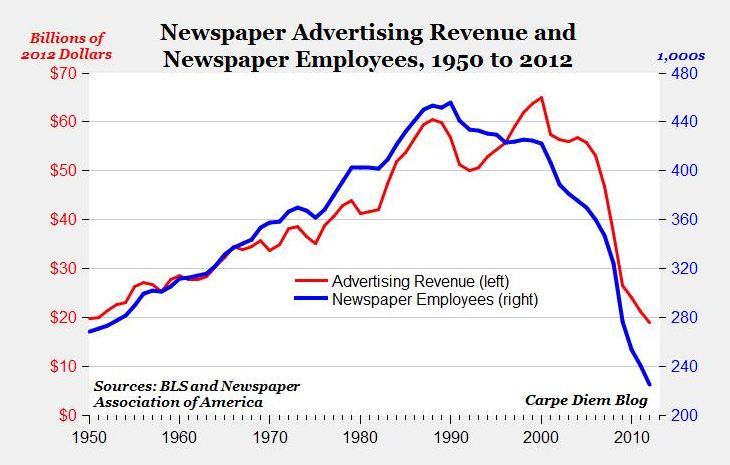
Further, newspapers are undercutting their own chances of bouncing back after the recession because in order to weather the current downturn they're cutting staff, undermining the quality of their product, and any likelihood of readers (and advertisers) rushing back in the future.
It's a terribly grim picture of this once-grand industry.
The New York Times announced recently that it would shift away from its partially subscriber-based model to solely an ad-based model. Here is one of the most valuable media properties in publishing changing its tune, and perhaps signaling a new tune for all newpapers. As reported in InformationToday, "All the News That's Fit to Print" became "All the News That's Fit to Give Away."
The number of subscribers was growing steadily. The total readership was 787,400, of which 227,000 were $50/year paying subscribers with the rest a combination of college students with free access (89,200) and home delivery subscribers to the print edition who chose to add TimesSelect at no extra charge (471,200). The service earned $10 million annually in subscription fees.
Then on November 13th, although Rupert Murdoch has yet to take formal ownership of Dow Jones and The Wall Street Journal, he told reporters: "We are studying it and we expect to make that free, and instead of having one million, having at least 10 million-15 million in every corner of the earth." The New York Times reported that "the Web site, one of the few news sites globally to successfully introduce a subscription model, currently has around one million subscribers, which generates about $50 million in user fees." (Apparently an understated number, as the minimum price for an online-only subscription is $79/year, with renewals at $99/year.)
Reactions to both announcements have been mixed. There's an emerging group of hardcore believers determibed that the future of the Internet lies solely in the success of advertising programs.
Others, like commentator Barry Ritholtz make some compelling points: "Thumb through either the print or online Journal, and you will see many high end, luxe advertisers. They are not attracted by the sheer volume of readers, but rather by the very appealing reader demographics: They pay a huge premium in ad rates to reach the highly educated, high income, tech savvy, free spending readers of the WSJ."
Meanwhile on November 1, Tom Curley, president and CEO of The Associated Press, in a speech to the annual Knight-Bagehot Dinner, offered several trenchant observations. "The portals are running off with our best stuff, and we're afraid or unable to make or enforce deals that drive fair value," he remarked. And later: "We must change how we charge for content. In the financial marketplace, hot news is the most valuable of all. Hedge funds pay premiums, add spiders and link to trading programs. One-size-fits-all on the business side has to evolve..."
As Mr. Ritholtz concluded, "Mr. Murdoch has shown over the years that he is a crafty businessman with a good feel for what the reading/viewing public wants. We'll find out soon enough what the fate of the firewalled WSJ.com will be..."
Exactly.
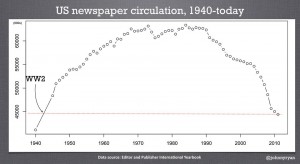
The Audit Bureau of Circulations (ABC) self-refers as the "Gold Standard in Media Audits" and is the place to go if you want to find out current U.S. newspaper circulation figures. Unfortunately, you have to be a member — they're not giving this sensitive information away — and so it's difficult to get up-to-the-minute data. You can find out the "Top 200 Newspapers by Largest Reported Circulation" (http://www.accessabc.com/reader/top150.htm), but not what those circulation figures actually are, and how they're trending.
But the ongoing decline in newspaper circulation in North America is not a well-kept secret, and if the ABC won't spill the beans, others will.
According to a February article in Media Life Magazine, "in the U.S., the circulation of paid-for papers dropped 4 percent from 2001 to 2005, hitting 53.3 million. It also dropped 2.3 percent in 2005 compared to the year earlier."
A May 2005 article in The Washington Post reported that "circulation at 814 of the nation's largest daily newspapers declined 1.9 percent over the six months ended March 31 compared with the same period last year…The decline continued a 20-year trend in the newspaper industry as people increasingly turn to other media such as the Internet and 24-hour cable news networks for information."
In the midst of this gloom, the February 17th issue of The Economist reported that in India there are some 300 big newspapers, and they experienced a 12.9% increase in circulation last year. Competition is fierce, and profits substantial.
The article also made reference to a key factor that may explain this bright news: Internet access is available to only 1.2% of Indians over the age of 12.
I remember years ago at a DRUPA trade show in Germany (DRUPA focuses on the printing business) meeting Naresh Khanna, the editor of Indian Printer & Publisher magazine. That year everyone was speculating about the possible impact of the Internet, but Naresh said to me: "Oh, we don't care very much about the Internet in India. We're just excited that we'll soon have color pictures in our newspapers."
© 2007 Arcadia House.
All Rights Reserved
Design and support
Rossul Design