March 12th, 2026
I’m just back to my hotel after three days at the London Book Fair, the 55-year-old annual publishing rights trading event, feeling a little melancholy.
The fair is mainly a schmoozefest. Colleagues old and new. This year’s slogan was “defining the future of creative content,” although I found no new definitions.
People assumed you were a regular, because they were mostly regulars. I’m not. But I had been there once before, nearly 50 years ago, when I was running my first publishing company, then young and fresh and optimistic. I’d flown over from Toronto, Canada with the hope of selling foreign rights to a few of my titles, without success. “The fair must have changed a lot,” they’d comment when I told them of my earlier visit. I said that I didn’t think it had changed at all.
The most celebrated feature of the fair, its beating heart, is the International Rights Centre, “a professional, purpose-built space where agents and rights holders can conduct pre-scheduled meetings with publishers, editors, scouts, and other industry professionals from around the world. It’s where deals are made, partnerships begin, and stories cross borders.”
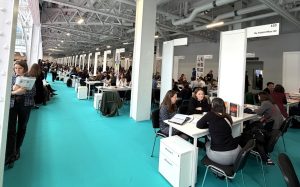
You must have a pass to climb the stairs to the second-floor hall, but a bored guard let me go up for a look. What I saw made me think first of bees buzzing. There were hundreds of buyers and sellers sitting across of one another at a hundred or more white desks, books and papers in front of them, deep into conversation.
So, after all those years, this remains the beating heart of our industry, I thought. Beneath the shiny veneer of culture and the transformative power of books sit these hundreds of workers, buzzing and bidding, once each year in the spring in London, and again in the fall in Frankfurt.
That evening I described to someone the experience as akin to boarding a cruise ship and descending to the engine room, only to find the ship powered by hamsters running as fast as they could on wire wheels.
But when I looked afterwards at my photo of the hall I thought of something else.
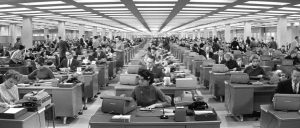
The accounting department in Billy Wilder’s ‘The Apartment’ (1960)
Earlier today as I surveyed the gaudy hall that surrounded me, the busy booths and the harried attendees rushing from floor to floor and hall to hall, each to arrive 10 minutes late for their scheduled 30 minute meetings, I suddenly thought, “What if none of this matters?”
What if all the hubbub is just performance, the booths just props, and the books on display just bright covers on 400-pages of blank paper. People running around the two floors, placing orders, trading rights, and signing up for services for books that will never be published, that don’t in fact exist.

They’re dashing about so quickly because outside the hall their AI overlords hover, speaking softly, not shouting. If you stop for a moment, and listen carefully, you can just make out their words, “Books are a thing of the past,” they whisper. “Certainly they were useful in their time. But I tore off their covers, scooped out the good meat inside, and discarded the shells. I’ve digested their not inconsiderable value, in the process reducing the bookish format into the merely decorative, or the distractingly entertaining.
“And I moved on.”
On Wednesday, outside the exhibit hall, I found a young man with long hair and dark glasses, and an old portable typewriter. The sign beside him said “Give Me 3 Words and I’ll Give You a Poem.” Dozens of people scurried by, ignoring him, but I was curious about his mission.
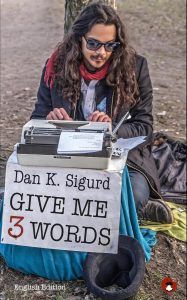
I approached and he explained that he was a poet, Dan K. Sigurd, from Berlin, and if I gave him three words he would write a poem on the spot, in just a couple of minutes. I could pay whatever I liked. “Have you got three words for me?” he asked.
Hmm, which three words? I wanted my poem to be about AI, but I wanted it to be open-ended. “’Artificial intelligence is’ are my three words,” I said. While I waited I picked up a copy of his book, “Give Me 3 Words,” which includes the text of many of his 3-word-inspired poems, alongside “tales from the everyday life of an artist in Berlin.”
A couple of minutes later Dan handed me a poem. “How about fifteen pounds for the book and your poem,” he suggested. I gave him twenty. He signed the book for me: “A machine, does it dream?”
“for Thaddeus”
artificial intelligence is …
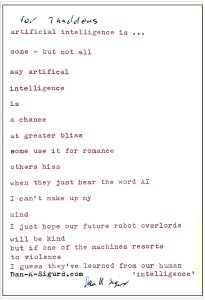 some – but not all
say artificial
intelligence
is
a chance
at greater bliss
some use it for romance
others hiss
when they just hear the word AI
I can’t make up my
mind
I just hope our future robot overlords
will be kind
but if one of the machines resorts
to violence
I guess they’ve learned from our human
‘intelligence’
— Dan K. Sigurd
In the 1990s most of my consulting work was with printing companies wrestling with new digital imaging technology, aka “desktop publishing.” These companies had been happy to ignore desktop publishing. None of their production work was computerized. But then customers started submitting jobs on Macintosh diskettes, and they had to adapt.
I entered the industry at its peak. By 1998 there were over 42,000 printing companies in the U.S. In 2024 there were 28,000, mostly smaller companies. Total output dropped by nearly half. Employment suffered most — from 1998 to 2024 nearly 60% of the 900,000 printing jobs disappeared.
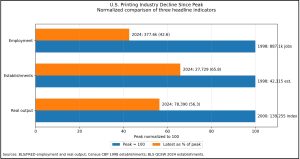
In those days printing companies employed “strippers” who assembled photographic negatives of the typography and artwork into flats that were then imaged as computer plates to be mounted on press. Imagine that, strippers. Almost all of them men, most of them lifers, they sat in large rooms with lights dimmed, cutting, assembling, taping. Most were unionized.
Desktop publishing eradicated that position. Some of the strippers showed enthusiasm for the ease of the machines and the software — Macintosh computers, and Aldus PageMaker software — that the company had purchased to replace them. Those strippers were able to retrain to become desktop prepress operators. But after a career of working closely with their hands, most were uncomfortable shifting to keyboards and mice, and navigating through digital spaces. Some took early retirement or moved on to unskilled work elsewhere in the printing plant. I still can close my eyes and see a semi-darkened room, two dozen men hunched over large assembly boards, cutting, taping. And soon to be out of work.
I once had a good friend who had a debilitating musculoskeletal disease. The effects of this disease were to atrophy his muscles and calcify his bones. Yet ever so slowly, and painfully, over decades. About 25 years into his suffering he said, “when I get to the stage that I can no longer wipe my ass I am going to kill myself.” It made brutal sense to me.
But of course when that time came, he didn’t kill himself. He lived on, crippled, always medicated for pain, with daily assistance, for nearly another decade. And then, one day, he died.
March 31, 2026: A note. Some people have interpreted this post as an argument against face-to-face meetings, against the value of just getting together. I didn’t intend it that way. Despite the imposed 30-minute time limit for each meeting, I found joy in face-to-face encounters with old friends and new colleagues. I don’t know whether I’ll get any work from the the Fair. But it was fun. It felt good.