March 24th, 2026
Here’s an account of the background to the New York Times report on Mia Ballard’s “Shy Girl,” and of my involvement in the saga.
I brought the “scoop” to the Times, and worked with them to develop it, although the published article obscures my involvement.
The Times landed a big story, republished and remarked on across the authoring and publishing world. It’s got over 700 comments on the Times site (Alexandra Alter’s story the next day, on Don DeLillo, has attracted 32 comments), and thousands more on Reddit and other social media. “Shy Girl,” is a big win for the Times. And a sad loss for the book’s author.
Shy Beginnings
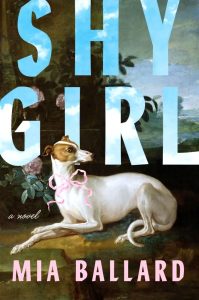
Proposed cover for the US edition of “Shy Girl”
I first heard about “Shy Girl” at the beginning of February, nearly two months ago, from Asia Laird, recently-hired as an account executive at Pangram, an AI detection software company. We were talking about various publishing issues and it came up in conversation that social media was buzzing with allegations about a book called “Shy Girl.” Asia sent me a link to a year-old Reddit thread. At the same time I found Hachette U.S.’s (now deleted) post about the acquisition of the book under its Orbit imprint, which it was “thrilled” to announce last July 30.
I could see that there was the potential for an interesting story.
There were several obvious parts. First, was “Shy Girl” in fact wholly or largely a product of AI? Assuming that the “science” indicated that the book was AI-generated, what next? Did it matter? Does anyone actually care?
Hachette had the U.S. release of the book scheduled for April (and, as I discovered, had already released the book last November in the U.K.). Was Hachette simply unaware of the A.I. accusations?
Trade publishers are (somewhat) quietly adopting AI tools themselves, dancing delicately around whether this conflicts with their public-facing “principles.” I was more than happy to use this story to highlight the conundrum.
When I read some of the online discussions I wondered if the story had already been told, and I’d just missed it. So I wrote to Jane Friedman, who writes The Bottom Line newsletter, to ask her if she’d heard about the allegations against “Shy Girl.” Jane replied that she wasn’t following it, though it had been “floating in (her) periphery.” She thought it was a story worth telling and said she would consider publishing my article if I didn’t land it elsewhere.
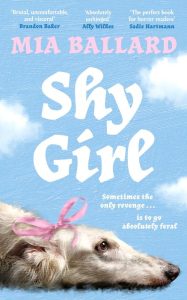
Cover for the UK edition of “Shy Girl”
First up was getting hold of a copy of the book. The self-published version was nowhere to be found, but Hachette’s U.K. edition was widely available on European ebook retail sites.
Hachette had done a good job enforcing its territorial sales restrictions. I tried to buy the U.K. edition from various U.K. and German sites. When I got to the payment window my order was refused each time. Oddly, Blackwell’s was willing to sell me a copy of the paperback, which I ordered, just in case, for delivery a week or so later. Separately I asked a friend in Austria to find a DRM-free copy of the Hachette book and to email that to me. He did so the next day. I converted the book to .docx, stripped out the extraneous material (there’s a bonus section and a bonus short story in the U.K. edition) — and sent it to Pangram. They responded overnight with their analysis of the book: “78.4% of the document is Al Generated” was their conclusion. I soon confirmed this with two other services.
Five Questions
Several intriguing topics dangled directly around the story (versus the broader issues the saga provokes). I worked on each of these and reported my findings to Alexandra.
1. Who is Mia Ballard? Her standard online bio reads “Mia Ballard is an American poet and fiction writer. She loves all things horror and is passionate about writing stories focused on feminine rage. She lives with her partner and dog in Northern California.” There’s no contact information online, nor in her self-published book. She has no web site. Hachette U.K.’s deal for Shy Girl wasn’t brokered by an agent — they contracted with her directly. Ballard has made brief comments on a few social media sites, but nothing on a regular basis, and nothing that provided contact information.
I would have liked to have interviewed Mia Ballard before proceeding with the story. But it wasn’t possible without going through Hachette, and I couldn’t go to Hachette without giving them a heads-up on the story (or else completely misleading them as to why I wanted to contact the author).
2. Is Shy Girl actually AI-generated? The word on the street about AI detectors is that they are seriously flawed and that their false positives can ruin careers. The latter is true. But like so much of AI tech, the detectors are a lot better today than they were two-three years ago when this became an established belief. I recommend a couple of academic papers:
https://www.nber.org/papers/w34223
https://dl.acm.org/doi/full/10.1145/3708889
 Pangram appears consistently near or at the top of several studies. I’ve known the founder, Max Spero, for a couple of years now, and have a lot of faith in the seriousness of his technical approach. That’s why I was willing to give credence to his report, particularly when it was backed up by reports from two other detection services that I’m also familiar with, Originality, and GPTZero, though less so than with Pangram.
That being said, I believe it’s still essential to use these reports only for guidance, not as proof of guilt. I’m willing to approach an author or a publisher when multiple detection reports reach the same conclusion, and say to them: “Let’s discuss this.” But there has to be an underlying presumption of innocence.
3. The paperback of Ballard’s self-published “Shy Girl” version appeared under an imprint called “Galaxy Press.” Galaxy Press is an imprint of the Church of Scientology. Its ISBN prefixes are 978-1592 and 978-1619. Ballard’s Galaxy Press print book appeared under two different ISBNs (the ebook didn’t include an ISBN). Neither were Scientology’s prefixes. So I concluded it was just a naming coincidence.
4. At what point did Hachette know that Shy Girl might be AI-generated? It strains credulity to imagine that no one connected with the book at Hachette knew about the online discussions. Why? Because the main reason a publisher acquires rights to a self-published book is because of all the online chatter (and the accompanying sales activity). The first accusations of AI use appeared online five-six months before Hachette announced that it was publishing the book. Was there no due diligence?
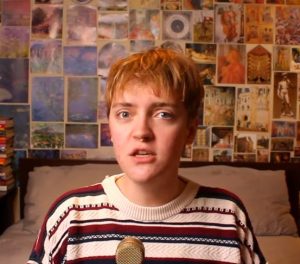
Frankie
The accusations continued to mount, culminating in a 2 hour and 40 minute YouTube video published online on January 19 by “frankie’s shelf,” called “i’m pretty sure this book is ai slop.” Frankie does not like the book, and exhaustingly dissects it.
5. Did Hachette republish “Shy Girl” as is? If Hachette had republished the book as it was in the original self-published edition, one small argument that could have been made was that they never examined the text closely with an editor’s critical eye. (A weak excuse, but still.)
As the YouTube “AI-generated video summary” describes it, “(Frankie) meticulously analyzes the writing style and structure, highlighting repetitive phrasing and questionable similes.” He presents a convincing argument. The video had over a million views even before the Times story appeared last week.
I was able to obtain the self-published Galaxy Press version via an interlibrary loan at San Francisco Public Library. I compared it to the Hachette UK version. Clearly copyedits were made. Also, an extra section “Before: Beverly’s Story,” was added to the novel, and “an additional spine-tingling short story,” “Harold,” was added after the novel.
Just the fact that the book was copyedited meant that Hachette was not just republishing the old self-published version — one or more editors were looking at the manuscript line by line (just as Frankie does on YouTube). But apparently even with a close textual examination, Hachette remained unaware that the text may have been at least partially AI-generated.
Enter the New York Times
I considered offering the story to Publishers Weekly, where I’m a contributing editor, but the magazine no longer runs substantial investigative pieces.
 Instead I contacted John Maher, the news editor at the New York Times Book Review. John had been one of my editors at Publishers Weekly, before he joined the Times last year, and we’d worked well together. John explained that he couldn’t invite me to write the story for the Times because of my role as an industry consultant. That I understood. Instead he assigned the story to Alexandra Alter, one of the Times long-standing publishing reporters. John assured me that her reporting would make it clear that I had brought the story to the Times, that I was the source.
I was pleased to be able to work with Alexandra, as I already knew her. I’d supplied background detail for several stories she worked on over the years, the first, in 2015, a story about customized print books.
Alexandra emailed me on February 6, the first of numerous exchanges over the next 5 weeks, including several phone calls. I was able to respond to each of her questions.
I grew frustrated by the slow progress in getting the story ready for publication. My main concern was that things might drag on into April, after the scheduled publication, or that the Times would suddenly lose interest, and I’d have to shop the story elsewhere at the last minute. I nudged Alexandra several times along the way and each time she assured me that things were moving forward.
I’ve wondered whether the delay had been to afford Hachette enough time to work out its response, though one Times article said that Hachette pulled the book within a day of first notification by the Times. (And a second article quoted Hachette as saying that “the decision to cancel the publication came after a lengthy and thorough analysis.”)
Hachette and Mia Ballard
Publishers have a responsibility to readers, but surely their responsibility to the authors is just as important.
I think that Hachette threw Mia Ballard under the bus, sullied and cancelled without a chance to defend herself in the court of public opinion. In her Times email she wrote that “this controversy has changed my life in many ways and my mental health is at an all-time low and my name is ruined for something I didn’t even personally do.” That outcome is troubling.
Why didn’t Alexandra Alter insist that she be allowed access to Ballard before running the Times story? I expect she requested contact information, though there’s nothing in the original article along the lines of “The Times tried to contact Ballard without success.” Perhaps there wasn’t time.
Cancelling the book was not Hachette’s only option. Why not go ahead and publish, with a clear advisory, and let readers judge? Own your mistake.
Way back in June 2025, Areen Ali, the Hachette commissioning editor who acquired the publishing rights, gushed in The Bookseller, “It’s been such a pleasure to work with Mia on refining her brilliant novel, I couldn’t be more excited to welcome her to the Wildfire list.” Eight months later, Hachette “values human creativity and requires authors to attest that their work is original” and Mia is gone, her career ruined.
What’s Next for Authors and AI?

The AI closet awaits
Authors, it’s time to climb back into the AI closet! Publishers were already anti-AI, and now they’ll be openly militantly anti-AI, all sanctimonious and solemn.
For authors that means that AI disclosure is not a good idea, even if it was used to write a single sentence. If already under contract, their book will likely be canceled. If under consideration, it will never be acquired.
But we all know that authors are using AI now, to various extents, and will use it more and more as the technology improves, and as author AI skills improve. But they will be required to swear that it was not used for anything beyond a smattering of research, and some spelling and grammar checking.
Given the current public revulsion with AI-generated text, and that authors are now forced to lie to publishers, publishers are going to have to resort to an AI detection process. That’s a damn shame. I recommend that publishers take my approach and run the same text through at least three different AI detection software services. And even then keep in mind it could be wrong.
Over time I think that authors, publishers and readers will simply accept that AI was used in the creation of most new books, sometimes a little, sometimes a lot. Authors will certify not so much “originality” as “responsibility” — I am responsible for these words; I claim them as my own.
What will matter then, as it does now, is whether the words resonate with the readers. Isn’t that the whole point?
These are AI teething pains. We’ll get there.
Postscript: The New York Times and I
While it’s great to be quoted in the New York Times, and I think highly both of John Maher and of Alexandra Alter, I’m distraught that I received not much more than a passing mention in the main article (and a quote in the short news piece). None of the news coverage of the Times article even hints at my role, and so there’s near-zero value to me from my involvement. I’ve not had any follow-up queries — why would I have? — I apparently had no role in the story.
I brought the story to the paper and was assured that I would be credited as the source. That didn’t happen. I’ve not had a query since the Ballard story broke.
I raised my complaint with Maher and Alter. Alter hasn’t replied, but Maher acknowledged my frustration and offered his support if I’d submit an op-ed piece as a follow-up. I wrote one and submitted it on Saturday, but was told by the opinion editor that they were already working with another writer on a similar idea. That would have been a good trade-off under the circumstances, but was not to be.
When we work with mainstream media we make a pact with the devil. On the one hand I can write a story the way I want to tell it, publish it on my blog, and reach a couple of thousand readers. On the other hand the New York Times has 12.33 million total subscribers. The choice should be easy. It is now. Stick to my blog.